
saving
Money you set aside is not money you spent
Savings are not expenses. Filing a transfer to savings as spending makes a good month look like a failure. Here's the fix, with numbers.
Short answer: no, savings shouldn’t count as expenses. Money you move into savings hasn’t left you; it has moved somewhere harder to reach. File it as spending and your best months start to look like your worst.
Here’s how that plays out, usually for the people who are doing well.
Payday lands on the 20th: €3,200. You move €270 into your emergency fund, because you promised yourself you would, and you’re pleased with yourself for about four minutes. Then you open the budgeting app you use, and it tells you you’ve spent €270 today.
A few days later the app says you’re over budget. By the end of the month it says the month was a write-off. So next month you stop moving money on payday, because the app keeps telling you it’s the reason you’re failing.
Nothing about your finances got worse. A category got mislabelled.
Spending is money that left. Saving is money that moved.
An expense is money that is gone: it went to a shop, a landlord, an energy company, and it is not coming back. A transfer to savings is money that changed rooms. It’s still yours. You could move it back this afternoon.
Those two end up in the same column in a lot of apps and spreadsheets because they look identical from the outside: an amount leaves the current account. But the outcome is the opposite. One makes you poorer. The other doesn’t touch your net position at all; it just makes the money harder to reach, which is the entire point.
The people who count this for a living don’t mix them up either. Eurostat defines household saving as the part of disposable income that is not spent on consumption, and euro-area households saved 14.3% of theirs in the first quarter of 2026. The 50/30/20 rule, popularised by Elizabeth Warren and Amelia Warren Tyagi in All Your Worth (2005), gives savings a bucket of its own, the 20%, separate from needs and wants. Links are at the end.
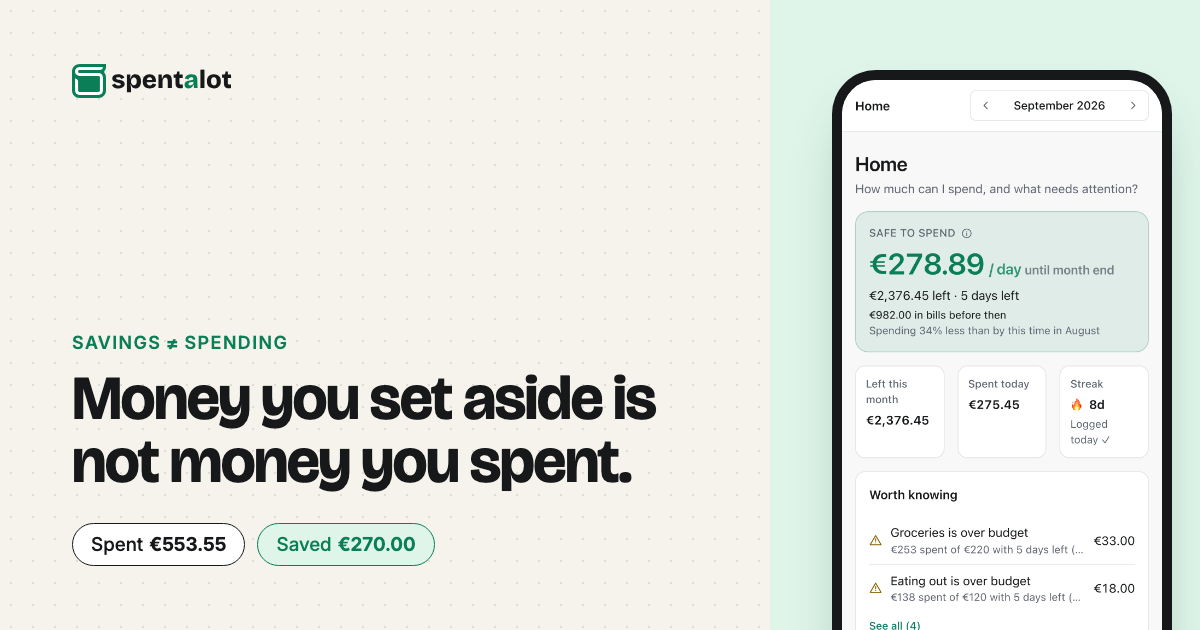
Once you file them together, your totals stop answering any useful question. Take this September: €553.55 actually spent, €270 set aside. Count the transfer as spending and the app reports €823.55 “spent”, nearly half as much again as what you really spent. Did you overspend? No idea. The number can’t tell you, and worse, it feels like it can.
This is why Spentalot keeps three separate totals instead of one: Spent, Saved, Invested. A contribution to a goal is a real transaction, dated, in a real wallet, visible in your list; it just never lands in the Spent column. The emergency fund in our example sits at €450 of €5,000, 9% of the way, and every contribution shows up there. Take money back out of a goal and Saved goes down. It’s not hidden, it’s not vanished. It’s filed where it belongs.
And when Budget projects where the month ends up, the headline number is your position: what’s in your wallets plus everything you set aside getting there. A month that sends €270 to a goal is not a month that lost €270. Your wallets are lower. You are not poorer. Both of those are true, and a budget that only shows you the first one is going to talk you out of saving eventually.
What’s safe to spend once savings come out first?
The second half of this is what it does to the rest of the month.
If savings are just another expense competing with groceries, then every euro is negotiable and none of it is decided. You spend the month in a low-grade argument with yourself about whether this is a save-more month or a live-a-bit month. You usually lose that argument around the 23rd.
The alternative is boring and it works: decide the set-aside on payday, before anything else. Move it. Then whatever remains is genuinely yours to spend.
That’s what “safe to spend” means once the set-aside is already out. It isn’t a limit you’re supposed to feel guilty about approaching. It’s what’s left after the bills that haven’t gone out yet and after the money you deliberately put away, divided by the days remaining. In our example, with the savings already moved, the wallets hold €2,376.45. Of that, €982 is bills still to go out: rent on the 30th, utilities on the 28th, Netflix on the 29th. That leaves €1,394.45 for the last 5 days of the month, or €278.89 a day. Spend all of it and nothing bad happens. That was the deal you made on payday.
The guilt people carry around spending is almost always guilt about a decision they never actually made. If you never decided what to save, every coffee is a referendum on your future. If you decided on payday, a coffee is a coffee.
The habit, in one line
Payday: decide the set-aside, move it, don’t revisit it. The rest of the month: spend what’s left, without narrating it.
That’s it. There’s no tier of discipline above this one. The people who are quietly good with money mostly aren’t budgeting harder than you. They’ve just moved one decision to the start of the month, where it only has to be made once, instead of relitigating it 200 times at the till.
A few notes from watching this go wrong:
Make the amount survivable. A set-aside you have to claw back a week later isn’t a plan, it’s a mood. Halve it if you have to. A boring €100 that stays put beats an ambitious €400 that comes back.
Taking money out isn’t failure. That’s what an emergency fund is for. It’s a withdrawal, recorded, and Saved goes down by exactly that much. Nobody needs to feel anything about it.
Check what your totals include. Whatever you use, an app, a spreadsheet or notes on your phone, look at whether transfers to savings are sitting inside your spending total. If they are, your month is being graded unfairly, and you’ll eventually take it personally.
None of this makes you save more this month. It just stops your own records from arguing against you while you do it. How much to set aside depends on your income, your bills and your plans; this piece won’t tell you the amount, only where to file it.
Spentalot keeps Spent, Saved and Invested apart from the first entry, so a month you saved in looks like one.
Sources
- Elizabeth Warren and Amelia Warren Tyagi, All Your Worth: The Ultimate Lifetime Money Plan, Free Press, 2005: the book that popularised the 50/30/20 split into needs, wants and savings. Book page on Google Books.
- Eurostat, “Household saving rate remains stable at 14.3% in the euro area”, news release, 3 July 2026: the definition of household saving (disposable income not spent on final consumption) and the euro-area rate for Q1 2026. Eurostat release.
The example uses the figures from Spentalot’s demo account (September 2026).
